
Works with Aurora hdr mac/pc version! Cityscape Photography – Aurora HDR 2019 Looks. The go-to Aurora HDR 2019 set for Cityscape photography and Street images. The set features 20+ beautiful looks. Works with Aurora hdr mac/pc version! FREE Aurora HDR presets – 2020 Limited collection. Also, a powerful addition to Aurora HDR 2020 is the Skylum’s latest Quantum HDR engine which is “powered by artificial intelligence” and, according to Skylum, offers impressive color enhancements without ghosting, noise artifacts and chromatic aberration (color fringing). Aurora HDR 2020 and Luminar 4 is a great bundle for editing your images.📽 Luminar 4.3 - New Features! Buy Me a Coffee: http.
Winning awards such as Apple’s Best Mac App and Digital Photo Editors’ Choice, Skylum software is set to unveil the next iteration of their AI-powered photo editing software in October. High dynamic range (HDR) image editing can often get the best of both newcomers and veterans alike, but Skylum aims to change that with their latest release.
Enter Aurora HDR 2020, an AI-powered all-in-one HDR image processing solution that Skylum is set to release on October 4. I’ve been a longtime supporter of Skylum, who takes a different approach to photo-editing software with both Luminar and Aurora HDR. The 2020 release of Aurora does not disappoint.
Shop Skylum Aurora HDR 2020 With Discount!
Get Luminar software with 10% discount, use Photominer’s coupon code 10PHOTOMINERS during checkout. Have a nice purchase!
Find more…
With brand ambassadors such as Jerry Ghionis, Joel Grimes, and HDR hall-of-famer Trey Ratcliff supporting and utilizing Aurora in their workflow, Skylum has gained a reputation for producing easy-to-use, powerful software since 2008. Take a few minutes to see Ratcliff work on images from Burning Man with Aurora 2020 here.
An easy adaptation of my workflow makes quick work of loading both bracketed sets or single images into Aurora for tone-mapping. Personally, I’ve installed the plugins packaged with Aurora to allow opening from both Lightroom and Photoshop, but Aurora also allows for plugin installation with Photoshop Elements and Apple Aperture as well. For users of tools such as Exposure X4, Aurora can easily be used as a standalone tool as well.
Once you save your tone-mapped image back to the corresponding folder, X4 should detect the new image for you to continue editing. Skylum has also brought Windows users into the fold with their tools, and the Windows version worked just as seamlessly as the Mac version throughout my testing.
Aurora 2020 HDR has a multitude of different Looks, with categories from Trey Ratcliff, Serge Ramelli, and Randy Van Duinen. Needless to say, there are quite a variety of Looks for editing your images. For the image below, I utilized the Bright Sun Look, making the image pop with just a single click. That’s impressive!
A new addition to Aurora 2020 is LUT (lookup table) Mapping, which gives the user further color grading options. The image above included the use of Faded Afternoon from the LUT Mapping tab. Skylum has designed Aurora to allow users to import their own LUT’s or navigate out to Skylum’s Marketplace for additional LUT packages.
I’m also impressed with the improvements made to one of the biggest telltale signs of HDR images, haloing, which is typically found around contrasting areas. I’ve reprocessed images that I initially used Aurora 2016 or 2018, and found immediate improvements to the trouble areas in the images. If for no other reason, this improvement justifies the argument for me on whether to upgrade or not.
What I Liked
- Great results, Fast
- Powerful LUTs
- Adjustment layers for global or targeted adjustments
- Opacity sliders on the HDR presets
What I Didn’t Like
- HSL Sliders don’t have a color picker
- Can’t reorder the filters
Final Thoughts
Overall, this is another home run from Skylum, giving their customers as much flexibility and power as they could hope for when working on HDR images. Personally, I hope people don’t go too extreme when playing with the different Looks and filters that Aurora offers, but hey, to each their own!
Regardless, Aurora has definitely earned a place in my bag of photo editors. If you haven’t purchased Aurora, you can preorder for $89, but for individuals looking to upgrade, your preorder cost will be $49.
Shop Skylum Aurora HDR 2020 With Discount!
Get Luminar software with 10% discount, use Photominer’s coupon code 10PHOTOMINERS during checkout. Have a nice purchase!
Find more…
When I first used HDR photography software, it was really jaw-drop moment. And from that day, I become addicted to HDR software.
We can not randomly pick any software without knowing it completely. An I right?
The only conclusion we can make for the best HDR software after using them personally. And we have made the work a lot easier for you!
Since this website is one of the trusted websites so definitely most of the software companies approach us to rate their products
And we asked for the license to check the credibilities, usage, and other HDR features required in blogging. And we also asked to provide a special deal exclusively for our readers.
Always love you mp3. So here is our honest guide on Top 5 Best HDR Software for Mac and Windows PC.
Overview
High Dynamic Range (HDR) refers to the difference between the light and dark extremes in your image.
When we look at a scene with our eyes, we’re able to perceive the range of contrast within that scene. Our eyes and brain are able to absorb and interpret quite a wide array of details that various light conditions provide.
Our camera sensors, on the other hand, have trouble capturing the difference of this range.
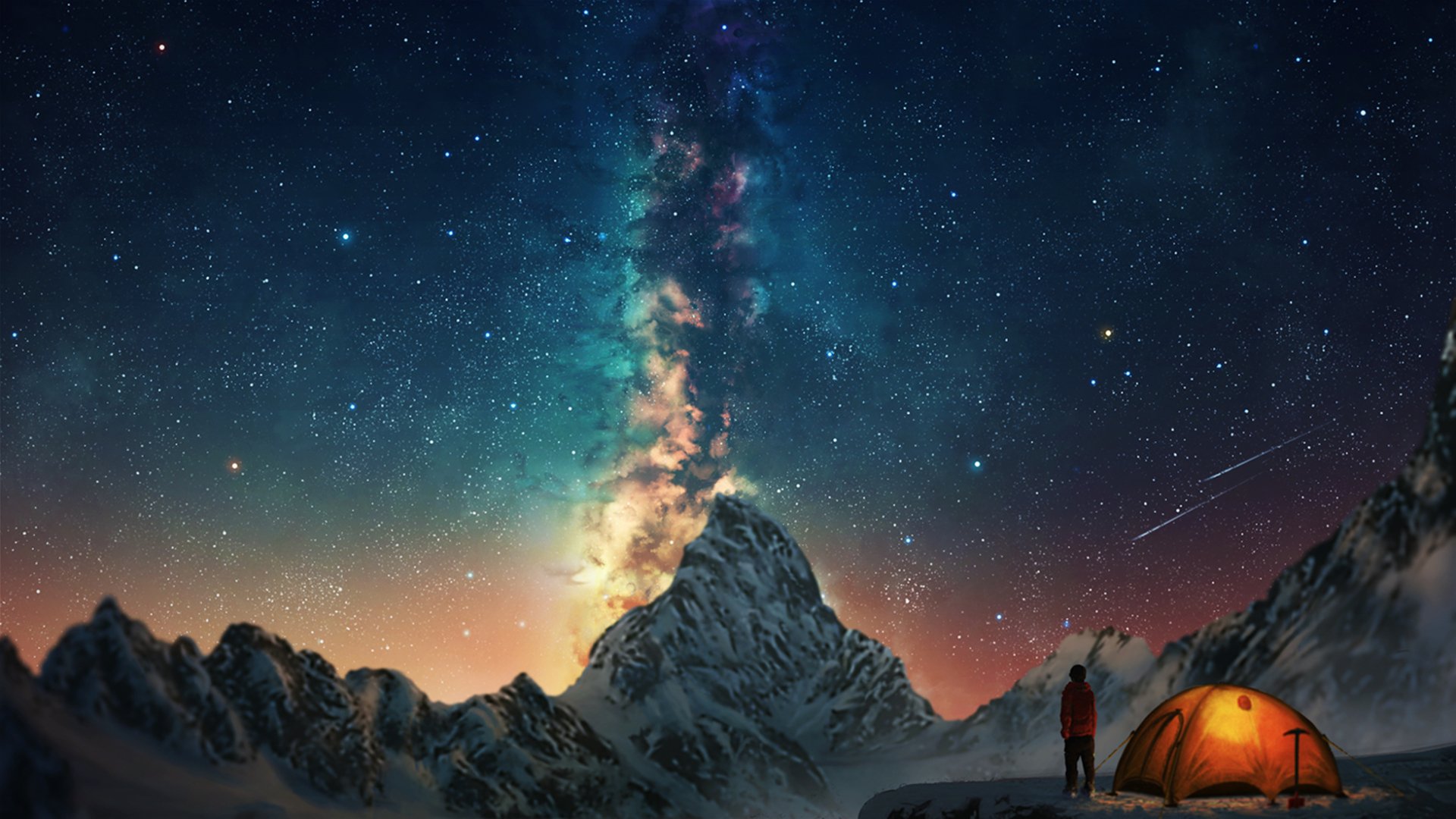
Say a photographer is shooting a mountain landscape at dusk, for example. How will he capture both the brightness of the sky and the darker nature of the mountains? He will choose an exposure with the idea that later on, in post-processing, he can further correct and enhance the lost details.
That’s why HDR photography has found its way into the photographic atmosphere — because, through a series of exposures or brackets, both your highlights and your shadows can be combined during the post-processing phase.
The idea for using several exposures was pioneered around the 1850s by Gustave Le Gray so that he could render both the sky and the sea in his seascapes. He used one negative for the sky and another negative (with a longer exposure) for the sea. He then combined these into one and a new scene was born.
Today, a photographer can choose to take three different exposures and then blend those files together with HDR software to find the exact look he wants. This results in an image that gathers the details of both the lights and the darks and gleans the necessary details that make that scene come to life.
Although camera sensor and resolution have evolved and new cameras are capable of capturing more dynamic range than older cameras — HDR photography is still needed at certain times to capture your scene. There are also some best Photography software and special offers to our readers such as Luminar, Photolemur, Franzis, and much more.
When to Use HDR Photography
As a good practice, stay alert for scenes that already have a contrast between their light and dark areas — as these are the kind that will truly benefit from HDR post-processing. Here are some examples.
Landscapes (Particularly, Cloudy Ones)
Landscape images provide a contrast between the land and the sky. HDR techniques on a cloudy but bright day will enable you to capture details and shadows of the scene.
Real Estate
Buildings and real estate offer reflections and views towards windows. Often, when we’re snapping these sort of shots, the scenes can cause the bright parts to turn white or the shaded areas to turn black. HDR techniques will help with these complex lighting situations.
Outdoor Portraits
Portraits done outdoors in the sunlight can cast a harsh light on your subject and produce dark and unflattering shadows. HDR techniques will help you to even out the image for a better portrait.
Backlit Scenes
If you find yourself snapping a shot of a scene that’s bright in the background — HDR will be able to lighten your foreground and give the scene the correct exposure without making it look washed out or dull.
When to Not Use HDR Photography
Of course, this is up to the photographer — though there are certain scenes that are said to be hard to capture with HDR photography.
Scenes with Movement
When a scene contains a moving object or when you, yourself, are moving — this may cause the images you create to not match.
Scenes with Incredibly Vivid Colors
If you find yourself capturing a scene with a wide array of incredibly vivid colours — that’s great. However, with HDR, if your scene is full of these vivid sorts of colour, there is a chance that HDR will cause them to look washed out.
What HDR Software Can Do For Your Images
The HDR software works to combine differently exposed images into one single HDR image. The software helps with things like tone mapping, image alignment, ghost removal, noise reduction and more.
When it comes to tone mapping, remember that you are compressing from a high dynamic range to a normal dynamic range (which lowers the contrast of your photo). Tone mapping brings back the mid-tone contrast and makes your HDR images more dynamic and full.
So far as image alignment goes, keep in mind that you are combining two or more images which can lead to misalignment. The HDR software helps greatly to fix to improve that.
By enabling ghost removal functions in your HDR combining process, you can avoid the problem of a ghost in your final images.
As you combine different exposures when creating HDR images, you will reduce noise and be left with a clear and clean end result.
How to Shoot Bracketed Images
As we’ve mentioned, HDR images are composed of multiple versions of the same image taken at different exposures.
If you adjust the aperture you’ll vary the Depths of Field. Adjusting the ISO will create more noise in certain images. So, you’re left with Shutter Speed.
First, set your camera on a tripod to make sure that the photos in your sequence will be aligned and the same. Set your ISO based on your given lighting situation. And then set your aperture.
As you vary the shutter speeds, place your camera on AV mode and use the Auto Bracketing feature if you have one.
Start by taking a photo at +/- 0 EV Metering for the mid-range of tones of your scene, then take one at -2 EV and one at +2 EV. In doing so, this will ensure proper image exposure and you’ll be ready to create your HDR image.
It’s often hard to decipher which HDR software will work best for you, so we’ve broken down 5 of the top HDR photography software that will help to give you incredible and dynamic images
- Aurora HDR
- Easy HDR
- Photomatix Pro
- HDR Projects
- Oloneo HDR
Top 5 Best HDR Software for Mac and Windows PC
1. Aurora HDR
Aurora HDR 2019 is developed by Skylum alongside world-famous HDR photographer, Trey Ratcliff. Their purpose is to make the often intimidating process of editing HDR photos easy. And today, it’s been downloaded over 1.7 million times with over 100 million photos edited. The latest version is enabled with AI Quantum HDR Engine.
In less than 2 years, Aurora HDR has edited an incredible amount of images with 72% of current users claiming to have made Aurora HDR their primary HDR photo editor (even if that required switching from another software).
Today, Aurora HDR is seen as the go-to for photographers like Serge Ramelli and Captain Kimo in addition to Trey Ratcliff.
Using Skylum Aurora 2019, you’ll be able to create natural-looking end results with your bracketed set of images. Edit the photo with additional filters and explore over 100 tools and features for different types of HDR photos.
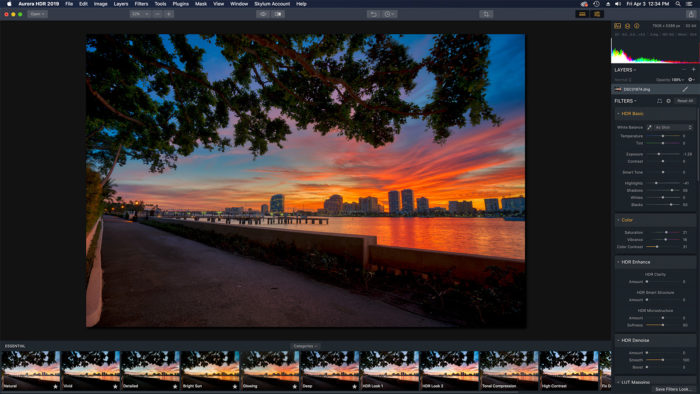
This HDR editor is available on both Windows and Mac and can also be used as a plug-in for Lightroom, Photoshop or Aperture. The latest features include a Lens Correction Filter (capable of fixing all sorts of distortion), vignetting, and chromatic aberration as well as a new user interface, and speed improvements.
There is up to 4x improvement in RAW image processing as well as up to 200% faster merging and masking performance. It also allows for natural or extreme HDR, so you can experiment with a wide range of creative effects depending upon your own style.
Overall, the interface is clean and the process is simple. To begin, you’ll click the Load Images button in the lower-left corner to bring up the Open file. Images can be processed as HDR Brackets (set by default, which means the software automatically sorts your exposure brackets and processes them accordingly.
After your images have been selected, you’ll click continue to see your options and settings. Click the checkboxes you want, fine-tune your adjustments, and you’re all set.
Here are some further details on what users can expect with the new version.
Aurora HDR Features
Quantum-HDR Engine – Thanks to AI-enabled Quantum HDR Engine that intelligently detects and improves HDR configuration.
Lens Correction Tool – easily fixes different kinds of lens distortion (from barrel and pincushion to chromatic aberration and vignetting)
New User Interface – Redesigned from the ground up, it’s said to be modern and responsive with a powerful but enjoyable HDR editing experience
Speed improvements – improvements up to 4x improvement in RAW and up to 200% faster in merging and masking performance
Cross-platform version – the software is available both for Mac and PC users with interchangeable files (mixed-computer households can share the same product key).
HDR Smart Structure – With AI technology, Aurora HDR gives users a unique experience when it comes to structuring your images. You can tune the details of the image.
HDR Clarity – Enhance the picture clarity precisely using HDR Clarity feature. You can customize the contrast on a particular section without affecting the whole image.
Layer & Masking – Aurora HDR comes with pre-built powerful layers, masking and you can customize the image as per your preferences.
2. Photomatix Pro
Photomatix Pro is another top pick of best HDR software for Mac and PC enthusiasts. It’s said to be a choice among artistic and more technical photographers alike, as it produces a variety of looks and effects.
We have also reviewed Photomatix Pro and the results are impressive.
The software uses different tone mapping algorithms to merge your series of images and create your HDR image. Explore options like Detail Enhancer, Contrast Optimizer, Tone Compressor and Exposure Fusion modes of the editor to yield unique results. Details Enhancer makes the image pop, Contrast Optimizer provides a natural-looking end result and Tone Compressor produces deep and vibrant colours.
To begin, open Photomatix and load your images into its simple layout. Salad days documentary.
When you’ve chosen the image files, you’ll click OK next and the control dialogue will be brought up.
You can enable or disable auto-alignment, de-ghost, noise reduction, chromatic aberrations and simple raw settings. If you enable the “remove ghosts” function, you’ll see the removal window and can choose either manual or automatic mode.
Next, you’ll branch into the realm of tone mapping the image. Enjoy a variety of presets which can be fine-tuned with sliders.
Hit apply and save and you’re ready to make more HDR images. You can also explore batch mode and create an HDR time-lapse.
Recently some latest updates are done on Photomatix Pro. Some of which are plugin for Capture One and Canon CR3 support, HDR Batch Plugin for Lightroom, and Photomatix Real Estate Camera App for iOS.
3. EasyHDR
easyHDR has been a choice among the best HDR software applications for over ten years. There are different versions and is consistently referred to as one of the best ways to produce HDR images.
Currently, easyHDR is available in Commercial as well as a Home user license.
The software is easy to install and quick to learn with a straightforward interface. Create multiple photos and blend them together for a photo sequence. You can also use the program for tone mapping to make your images look more natural.
It has the capabilities to import several image formats: JPEG, 8/16-bit TIFF, PNG, FITS or any RAW photo. And also import OpenEXR (*.exr), Radiance RGBE (*.hdr) and 96-bit floating-point TIFF HDR images which are edited with other HDR software.
There is also an option of processing a single image (a featured called LDR or Low Dynamic Range enhancement).
After taking your set of images, load the HDR photo sequence by dropping your files on the easyHDR program icon, on the easyHDR workplace or by clicking the “New” button to open File import dialogue and select the images. You can also use easyHDR as an external editor in other photo processing software or as a plug-in for Lightroom.
Keep in mind that instead of processing the HDR sequence, you can also load just a single photo for “LDR enhancement”(best results are achieved if RAW (or 48-bit TIFF) image is processed).
Preprocessing options for the input photos are Chromatic Aberration correction as well as Alignment (manual or automatic).
After pre-processing the photos, you can now generate your HDR image (and filter it to reduce the noise). You can also use ghost removal or apply basic image transformations like rotation, flip, and crop.
Next, explore various settings and presets to get the result you desire. Process the photos using available filters, save your image and share!
Updates!
Recently there are some major improvements done by the EasyHDR professionals and the major is done on lens correction and also a Faster painting with clone/healing tool improvements.
And some of the extra features added in January 2020 such as Local Contrast which we called HDR Clarity in Aurora HDR.
There is also a new defringing option that let users get better chromatic aberration correction.
4. HDR Projects 7
HDR Projects 7 is an HDR software with an assortment of customizable features. It’s available on both Mac and Windows and is straightforward and easy to begin using.
It’s directed at everyday photographers to reduce the amount of time on their HDR sets and provide new possibilities to transform photos. It offers an intelligent and adaptive tool-set as part of its workflow — in addition to a professional toolbox with a collection of presets and filters.
In a few seconds, HDR Projects will analyze your photos and use the date to generate more than 100 recommendations for image improvement. You won’t need to press any buttons, adjust the sliders or test functions. The image recommendations with HDR montages will provide creativity and the operation can be used as a standalone or plug-in.
Now in 4K resolution, you can arrange your tools however you’d like. The image quality is optimal and provides clean HDR photos free of noise. 155 adjustments and professional presets offer new possibilities for your photography.
Available for both Mac and Windows, HDR Projects is a simple way to start producing your HDR photos.
You can even insert a new sky or remove certain elements of your image and replace them with other features using the Composing function.
Enjoy the modern interface and have fun sharing your creations with your social channels and photo enthusiast friends.
HDR Projects 7 Features
Recently the latest 2020 version launched named HDR Projects 7, there are many quality features included which are waited for so long, some of them are
Highlight Boost – Ideal for low light shooting and it improves the depth of image by optimizing lightening.
Image Alignment – If offers you a unique feature to align your picture according to the photography mode you are choosing such as Landscape, architect, high rise buildings, and much more.
Colour-exact tone mapping – For making precise changes, this feature gives you an exact colour match to your image without any artefacts.
There are also some extra professional presets included in the latest version and it is used as plugin along with the standalone application.
5. Oloneo HDR
Oloneo HDR is an HDR and RAW photo processing software by Oloneo.
As their website states, “At the core of Oloneo HDRengine is a fully real-time, 32-bit floating-point per channel (96-bit per pixel), High Dynamic Range (HDR), ultra-wide gamut, full resolution and non-destructive image-editing engine.”
Aurora Hdr 2020 Versions
Its colour model handles a range of colours and it’s the suppression of any colour shifting and clipping helps to guarantee the loss of image data during the HDR process.
The user interface is intuitive and responsive and the image controls work at a real-time rate for the professional and amateur alike.
Oloneo PhotoEngine comes with a Lightroom plug-in and direct export. The process is made easy to understand and includes features like instant raw photo and image thumbnails, full, real-time edition history with animated replay, full documentation and video tutorials that are accessible from within the application.
Factory presets help beginners. Automated tools simplify the process and the real-time HDR makes for a unique experience.
HDRengine allows for full real-time tone mapping and HDR manipulations (with both multiple exposures and single photos). It provides three tone mapping engines, auto-exposure correction with fine-tuning, auto-contrast, ghost removal tools, auto-align, auto-orientation, and more.
The HDR process is made efficient with an organized workspace.
Conclusion

High Dynamic Range — HDR — is the thing that accounts for the differences in light and dark extremes of your scene — and through our eyes can perceive the scene and its range of contrast, our camera sensors can’t always do so.
That’s why HDR photography and HDR software have been making such a name for themselves in the world of image-creating. Through a series of exposures or brackets, you are granted the possibility to combine both your shadows and your highlights during the post-processing phase.
Aurora Hdr Free Trial
From the variety of HDR software available, these top 5 software yield different but incredible results. From Aurora HDR to EasyHDR, to Photomatix Pro, to HDR Projects, to Oloneo HDR — these professional editors will suit a variety of photographers interested in HDR photography.
Aurora Hdr 2020 Free Trial
Whether you’re shooting landscapes, real estate, architecture, portraits or more, experimenting with HDR photography is a fantastic way to branch into a creative and unique aspect of your photo-taking.
Aurora Hdr Reviews
You may also like:
I hope you like this tutorial about best HDR software for Mac and Windows PC. For more Articles on Mac and other tech stuff, you can follow us on Facebook, Twitter.