
- 2001 Mars Odyssey Mission Pin 1 X 3
- 2001 Mars Odyssey
- Odyssey Spaceship
- 2001 Mars Odyssey Challenges
- 2001 Mars Odyssey Spacecraft
NASA'S 2001 MARS ODYSSEY SPACECRAFT POISED TO ARRIVE AT MARS After 200 days of travel and more than 460 million kilometers (about 285 million miles) logged on its odometer, NASA's 2001 Mars Odyssey spacecraft will fire its main engine for the first and only time Oct. 23 and put itself into orbit around the red planet. Mars Odyssey was part of NASA's Mars Exploration Program as reformulated after a series of probe failures. Mars Odyssey arrived at Mars in October 24, 2001, with the primary science mission spanning January 2002 through July 2004. The mission was to map the amount and distribution of chemical elements and minerals that make up the Martian surface.
The 2001 Mars Odyssey, formerly MGM (Mars Global Mapper), is the remaining part of the Mars Surveyor 2001 Project, which originally consisted of two separately launched missions, The Mars Surveyor 2001 Orbiter and the Mars Surveyor 2001 Lander. The lander spacecraft was cancelled as part of the reorganization of the Mars Exploration Program at NASA. The orbiter, renamed the 2001 Mars Odyssey, will nominally orbit Mars for three years, with the objective of conducting a detailed mineralogical analysis of the planet's surface from orbit and measuring the radiation environment. The mission has as its primary science goals to gather data to help determine whether the environment on Mars was ever conducive to life, to characterize the climate and geology of Mars, and to study potential radiation hazards to possible future astronaut missions. The orbiter will also act as a communications relay for future missions to Mars over a period of five years.
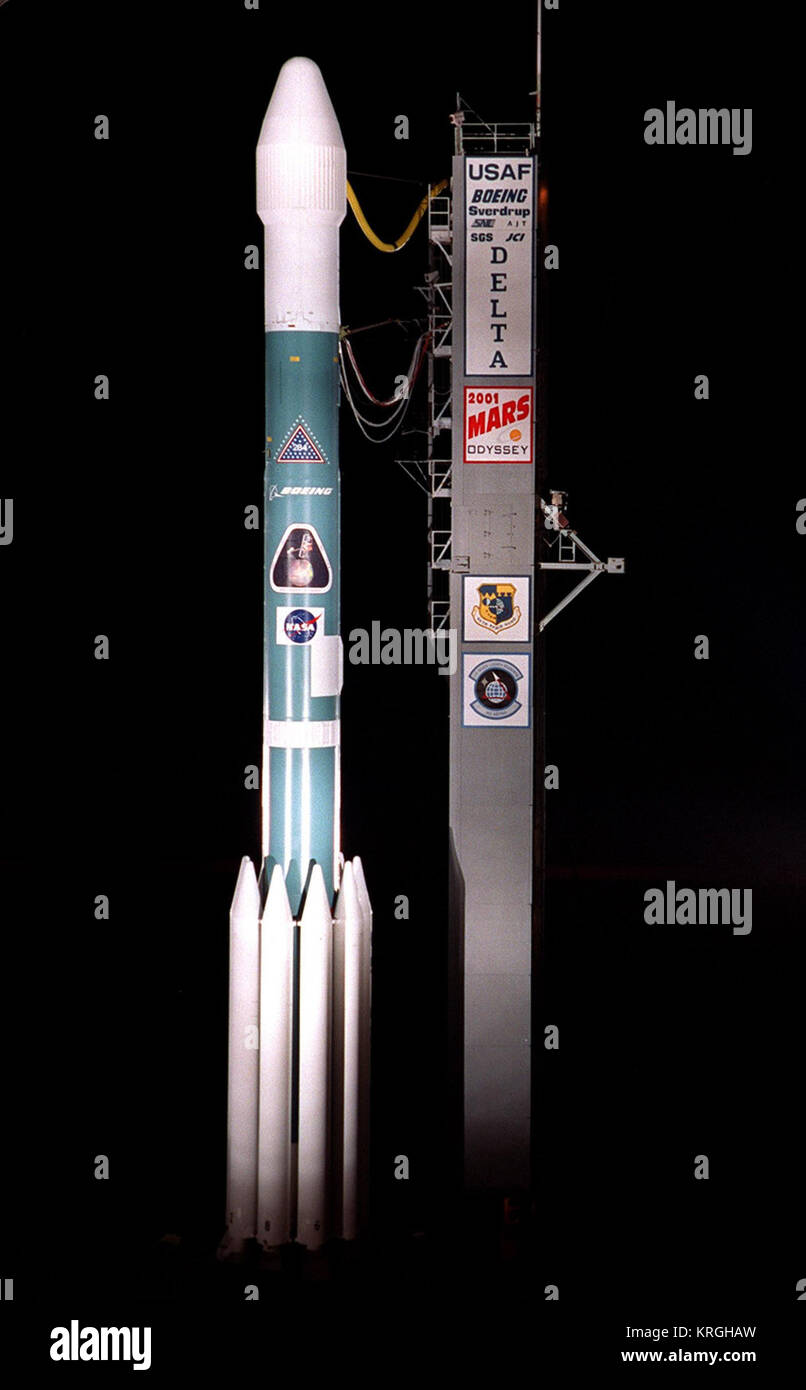
The 2001 Mars Odyssey launched on 7 April 2001 at 15:02:22 UT (11:02:22 a.m. EDT). During the cruise to Mars, in August, the MARIE instrument failed to respond during a routine data transfer and was put into hibernation. Attempts to revive the instrument were successful in March 2002 and MARIE began taking scientific data from orbit on 13 March. The star tracker camera is having difficulties with too much stray light, it is thought that this will not affect its operation severely. After a seven month cruise the spacecraft reached Mars on 24 October 2001 at 02:26 UT (23 October 10:26 p.m. EDT). The spacecraft used a 19.7 minute main-engine propulsive maneuver to transfer into an 18.6 hour elliptical capture orbit and used aerobraking until 11 January 2002, when the spacecraft pulled out of the aerobraking orbit into a 201 × 500 km orbit. This orbit was trimmed over the next few weeks until it became a 2-hour, approximately 400 × 400 km polar science orbit on 30 January 2002. The Orbiter will act as a communications relay for the Mars 2003 Rovers, scheduled to arrive in January 2004, and possibly other future missions. Data will be collected from orbit until the end of the 917 day nominal mission in July 2004. The spacecraft will continue to act as a communications relay until October 2005.
The 2001 Mars Odyssey carries
- the Mars Radiation Environment Experiment (MARIE), which will measure the near-space radiation environment as related to the radiation-related risk to human explorers,
- the Thermal Emission Imaging System (THEMIS), which will map the mineralogy of the Martian surface using a high-resolution camera and a thermal infrared imaging spectrometer,
- the Gamma-Ray Spectrometer (GRS), which will map the elemental composition of the surface and determine the abundance of hydrogen in the shallow subsurface.
- star cameras.
The main body of the 2001 Mars Odyssey is box-shaped, 2.2 meters × 1.7 meters × 2.6 meters. The spacecraft has a launch mass of 725.0 kg, including 348.7 kg of fuel. The orbiter is divided into two modules, the upper equipment module holds the equipment deck which supports the engineering components and the science instruments. Above the equipment module, connected by struts, is the science deck, holding the star cameras, high energy neutron detector, UHF antenna, the THEMIS instrument and a deployable 6 meter boom holding the gamma sensor head for the GRS. A set of solar array panels extends out from one side of the main bus. A parabolic high-gain dish antenna is mounted on a mast extending from one corner of the bottom of the bus. The MARIE instrument is mounted inside the spacecraft. The lower part of the bus is the propulsion module. The main engine, a hydrazine and nitrogen tetroxide rocket which can produce 65.3 kg thrust, is mounted in the bottom part of the propulsion module, along with the fuel, oxidizer and helium pressurization tanks.

Attitude control is provided by four 0.1 kg thrusters and the spacecraft can be turned using four 2.3 kg thrusters. The spacecraft is three-axis stabilized using three primary reaction wheels and one backup. Navigation is provided by a Sun sensor, star camera, and inertial measurement unit. Power is provided by the gallium arsenide solar cells in the solar panel and a 16 amp-hr nickel hydrogen battery. Communications between the orbiter and Earth are in X-band via the high-gain antenna and communications between the orbiter and any Mars landers are via the UHF antenna. Thermal control is achieved using a system of heaters, radiators, louvers, insulating blankets and thermal paint. Command and data handling is through a RAD6000 computer with 128 Mbytes RAM and 3 Mbytes of non-volatile memory. [NASA]
| Apr. 1, 2021. Odyssey Release 75 includes new data from THEMIS and GRS. The GRS release also includes re-processed versions of all previous NS and HEND raw and derived data products. |
The 2001 Mars Odyssey Orbiter has been mapping Mars since February 18, 2002. The orbiter carries three science experiments:
- THEMIS, a thermal emission imaging spectrometer;
- GRS, a gamma ray spectrometer suite;
- MARIE, a radiation experiment.

2001 Mars Odyssey Mission Pin 1 X 3
Also archived are:
- Radio Science data,
- Accelerometer data,
- SPICE data.
More information can be found on the Odyssey web siteat JPL.
The Geosciences Node archives GRS and Radio Science data, and oversees the archiving process for all Odyssey data sets.
2001 Mars Odyssey
Data
Follow the links above to find Odyssey data products online.
Odyssey Spaceship

The Mars Orbital Data Explorer (ODE) here at the Geosciences Node provides search capabilities for Odyssey data.
Odyssey instruments release new data to PDS every three months, on or near the first of January, April, July and October. Subscribe to the PDS Data Notification Service to be informed of new data releases.
Documents
The Odyssey Archive Plan describes the generation, validation, and release of Odyssey science archives. (Rev. 1, April 16, 2003, 179 KB, PDF)
2001 Mars Odyssey Challenges
PDS Catalog information is archived along with the science data:
2001 Mars Odyssey Spacecraft
Instrument Descriptions for THEMIS, GRS, MARIE, and Radio Science